
The Future of Hiring Has Already Started
The staffing world is undergoing a massive transformation.
Gone are the days when hiring meant posting a job, waiting for resumes, and conducting endless interviews.
In 2026, companies want hiring to be:
-
Faster
-
More accurate
-
Skill-based
-
More automated
-
Less dependent on guesswork
And job seekers now expect:
-
Transparency
-
Skill recognition
-
Faster responses
-
Remote-friendly opportunities
-
Clear growth paths
This blog breaks down the latest staffing trends, modern challenges, and future-ready strategies that every business must adopt in 2026.
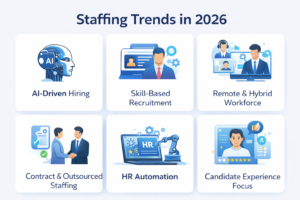
1. AI-Driven Staffing Is Now Standard
AI has officially become the backbone of staffing in 2026.
Companies are using AI to:
-
Screen resumes automatically
-
Match candidate skills with job roles
-
Predict candidate success
-
Reduce hiring bias
-
Automate interview scheduling
-
Run chatbot-based pre-screenings
Result:
✔ 60% faster hiring
✔ 40% lower recruitment cost
✔ Better quality candidates
Staffing firms that don’t shift to AI will struggle to compete.
2. Skill-Based Hiring > Degree-Based Hiring
2026 has made one thing clear:
Skills matter more than certificates.
Industries adopting skill-first hiring:
-
IT & Software
-
Logistics
-
Marketing
-
Manufacturing
-
Retail
-
Customer Support
Companies now focus on:
-
Real-world projects
-
Practical tests
-
Portfolio-based evaluation
-
Certifications from credible platforms
This approach leads to better employee performance and lower attrition.
3. Remote & Hybrid Workforce Is the New Default
Remote hiring is no longer “just an option.”
It’s now a strategic advantage.
Trends in 2026 include:
-
Global hiring without boundaries
-
Hybrid teams for flexible operations
-
Virtual onboarding systems
-
Cloud-based HR tools
-
Digital employee experience management
Remote staffing gives businesses access to global talent at lower cost.
4. Outsourcing & Contract Staffing Surge in Demand
Companies prefer flexibility in 2026.
Top choices:
-
Contract staffing
-
Project-based hiring
-
Freelancers
-
Outsourced teams
-
Temporary-to-full-time roles
Why?
-
Reduces long-term overhead cost
-
Speeds up project delivery
-
Reduces operational risks
-
Helps scale up/down instantly
This is especially popular in IT, logistics, healthcare, and FMCG.
5. Automation Reduces 40% of HR Workload
2026 HR tools handle:
-
Attendance & payroll
-
Employee onboarding
-
Document verification
-
Performance analytics
-
Background checks
This allows HR teams to focus on:
-
Culture
-
Employee retention
-
Leadership development
-
Growth strategies
Automation = efficiency + accuracy + speed.
6. Candidate Experience Becomes a Top Priority
Candidates today behave like customers.
If their experience is poor, they move on.
In 2026, companies win by offering:
-
Faster responses
-
Transparent job descriptions
-
Clear salaries and benefits
-
Smooth onboarding
-
Growth-focused communication
A great experience = better talent = stronger brand.
7. Data-Driven Staffing Decisions
Recruitment now runs on metrics, not assumptions.
Companies track:
-
Time-to-hire
-
Cost-per-hire
-
Quality of hire
-
Attrition reasons
-
Skill gaps
-
Productivity metrics
This helps create a scalable, future-proof hiring system.